

staircase measurement
About This Project
Getting the right measurements is the first step in any easy DIY stair remodel. Ill-fitting treads can look unprofessional and compromise safety. This guide will walk you through how to measure your stairs precisely, ensuring your new treads fit perfectly for a look that brings warmth and elegance to your home.
Steps
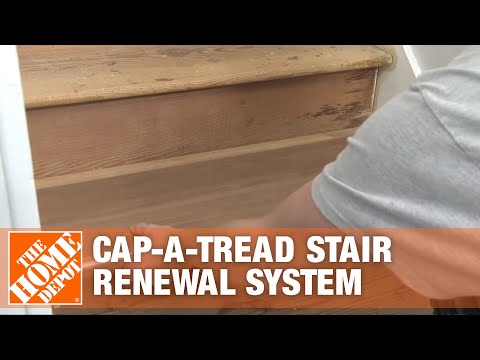
Step 1: Count Your Treads & Gather Your Gear
5 minutesFirst, count the number of horizontal surfaces you actually step on—these are your treads. You'll likely notice you have one more vertical riser than you have treads. Now, let’s gather your tools for the job: a good quality, rigid tape measure, a carpenter's square, a level, some masking tape, and a pencil. Having everything on hand makes the process smooth and stress-free.
Watch: Measure Treads and Mark Laminate
Step 2: Measure the Depth of Each Tread
2 minutesFor each individual step, place your tape measure firmly against the vertical riser (the back panel of the step). Extend the tape straight across the flat part of the tread and over the rounded front edge, which is called the 'nosing.' It's crucial to keep the tape measure flat and level for an accurate reading. Important: Always measure the bare wood. Do not measure over old carpet, pads, or adhesive residue, as this will give you an incorrect measurement and compromise the fit. Record the depth for each step before moving to the next.
Watch: Measure Stair Tread DepthStep 3: Measure the Width of Each Tread
2 minutesPosition your tape measure to run across the tread, parallel to the back riser. If your staircase is enclosed between two walls, measure from wall to wall. If one or both sides are open, measure from the absolute edge of the tread to the other side. For a classic, design-conscious look, many homeowners leave about a 1-inch border of exposed wood on each side. For example, a 36-inch wide stair often looks best with a 34-inch wide tread. Make sure to record the width for each individual step.
Watch: Measure Stair Tread WidthStep 4: Record, Double-Check, and Document
5 minutesWrite down the width and depth for every single step. It’s not uncommon in homes for steps to have slight variations. If you find any differences, use your masking tape to label each unique step with its number. If you're planning to order our custom-made treads, taking a quick photo of any uniquely sized steps along with your written measurements is incredibly helpful. Remember the carpenter's rule: measure twice, order once. This simple habit provides peace of mind and ensures a result you'll be proud of.
Watch: Measure Treads and Mark LaminateFrequently Asked Questions
What specific tools and materials will I need to accurately measure my stairs for new treads?
You'll primarily need a reliable metal tape measure for rigidity and precision, a pencil, and paper or a notebook to record your findings. For extra accuracy, especially with irregular steps, consider using a straight edge or a digital measuring device. These tools will ensure you get the exact dimensions needed for a perfect fit.
Are there any safety precautions I should take when measuring my stairs to prevent accidents?
Always ensure the staircase is well-lit and free of any obstructions or clutter before you begin. Exercise caution and maintain good balance, especially when leaning or reaching to measure. If steps feel loose or unstable, address them temporarily for safety before taking measurements to avoid falls.
Is measuring stairs a truly beginner-friendly project, and can I realistically complete it within the estimated 60 minutes?
Yes, measuring stairs is a beginner-friendly task as it relies more on careful attention to detail than complex skills. The 60-minute estimate is generally realistic for standard, straight staircases. However, stairs with unusual angles, winders, or a large number of steps might take a bit longer, so plan accordingly.
What are the most common measurement mistakes people make, and how can I avoid them for a perfect tread fit?
A common mistake is assuming all steps are identical; always measure the width and depth of each individual tread. Another error is not measuring the depth at multiple points if the nosing or back of the tread is inconsistent. To avoid issues, double-check every measurement and record them clearly before ordering any materials.
Besides a standard tape measure, are there alternative methods or tools for measuring stairs, especially if they have unusual angles or turns?
For complex or winding staircases, a stair-tread template tool or an adjustable stair jig can be invaluable. These tools allow you to perfectly capture irregular shapes and angles, ensuring your new treads fit precisely. Digital laser measuring devices can also offer increased speed and accuracy for various stair configurations.
Why is precise measurement so crucial for stair treads, and what are the potential consequences of inaccurate measurements?
Precise measurements are critical for both aesthetic appeal and safety. Ill-fitting treads can result in unsightly gaps, an unprofessional finish, and, more importantly, create tripping hazards. Inaccurate measurements can also lead to wasted materials and additional costs if new treads need to be re-ordered, delaying your project.