

measuring your stairs for treads
About This Project
Ready to elevate your staircase? Getting that perfect, custom-made to fit look starts with one simple step: accurate measurements. This guide will walk you through how to measure each step for your new carpet treads, ensuring a flawless fit that provides both safety and style. Even in new homes, stairs can have slight variations, so measuring each one is key to a professional-looking DIY result and the first step toward peace of mind.
Steps

Step 1: Get Your Count and Your Kit
5 minutesLet's start with a quick count of the individual stair treads on your staircase. Here’s a handy tip: you’ll always have one more riser (the vertical part) than you have treads (the flat part you step on). Once you have your count, gather these DIY-friendly tools: a good, rigid tape measure for accuracy, a carpenter's square for checking angles, a level, some masking tape, and a trusty pencil and notepad.
Watch: Determine Staircase Dimensions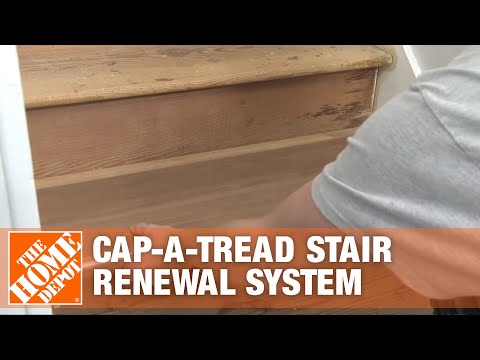
Step 2: Measure the Depth (Front to Back)
2 minutesWorking one step at a time, measure the depth. Place the end of your tape measure firmly against the riser (the vertical back of the step). Extend it straight across the tread surface and over the rounded front edge, known as the 'nosing.' It's absolutely critical for a perfect fit that your tape measure lies flat against the clean wood surface. Measuring over old carpet remnants or adhesive will give you an incorrect measurement, so be sure the surface is clear.
Watch: Measure Treads and Mark Laminate
Step 3: Measure the Width (Side to Side)
2 minutesTo measure the width, run your tape measure from side to side along the front edge of the step, keeping it parallel to the riser. If your stairs are between two walls, measure wall-to-wall. If one side is open, measure from the wall to your other boundary. To achieve that polished, intentional design, we recommend leaving a small border of exposed wood. For example, a standard 36-inch wide stair looks fantastic with a 34-inch tread, leaving a 1-inch border on each side.
Watch: Measure Stair Tread WidthStep 4: Record and Double-Check Your Numbers
3 minutesIn your notebook, create a simple chart and record the width and depth for each tread. It might seem tedious, but even stairs in newer homes can vary slightly. If you find a step with different dimensions, make a special note and number that step on your chart. For the ultimate peace of mind, especially when ordering our custom-made to fit treads, taking a quick photo of any unusual steps is a huge help. Remember the carpenter's rule: measure twice, order once!
Watch: Measure Treads and Mark LaminateFrequently Asked Questions
What specific tools do I need to accurately measure my stairs for treads?
You will primarily need a sturdy metal tape measure for precise readings, a notepad and pen to meticulously record each step's dimensions, and potentially a straightedge or carpenter's square to ensure your lines are perfectly straight. A calculator can also be handy for quick verification of your numbers.
My stairs aren't perfectly uniform. How do I handle slight variations between individual steps?
It's very common for stairs to have slight variations in width and depth, even in newer homes. The key is to measure each step individually for both its width and its depth. Record these specific measurements for each corresponding step to ensure every tread fits perfectly and looks professional.
Are there any safety precautions I should take while measuring my staircase?
Yes, always prioritize safety. Use a stable step stool or ladder if needed to comfortably reach higher steps without overextending. Be mindful of your footing, especially if the stairs are already slippery, and avoid rushing the process. If possible, have someone present to spot you.
How long does it typically take to measure a standard staircase, and how difficult is the process for a beginner?
Measuring a standard 12-14 step staircase usually takes between 30 to 60 minutes, depending on your attention to detail. It's considered a beginner-level DIY task; the difficulty lies not in complex techniques, but in the need for patience and meticulous accuracy to avoid mistakes.
Why do I need to measure each step individually instead of just measuring one and assuming they are all the same?
Each stair tread can have subtle differences in width and depth that aren't always visible to the eye. Measuring every step individually guarantees a custom fit for each tread, which is crucial for preventing unsightly gaps, uneven overhangs, and achieving a truly polished, professional appearance.
What's the best way to record my measurements to prevent errors and make ordering easier?
Draw a simple diagram of your staircase and number each step from bottom to top. As you measure, write down the width and depth for each corresponding step number directly on your diagram. Double-check each measurement against your diagram immediately after recording it to catch any potential mistakes.