

curved-stair-measurement
About This Project
Winding or curved staircases add architectural beauty to a home, but finding stair treads that fit can feel like a challenge. The solution is a simple, DIY-friendly measurement process to create templates for treads that are custom-made to fit each unique step. This guide will walk you through measuring the width, depth, and curve of each tread, ensuring your new treads elevate your staircase with a look that is seamless, safe, and stylish.
Steps

Gather Your Tools for a Perfect Fit
10 minutesSetting yourself up for success starts with having the right tools on hand. For this project, you will need: a flexible measuring tape (essential for accurately following the curve of each tread), a protractor or angle finder to capture the angle of any tapered steps, and a level. You will also need paper or cardboard to create the templates that guarantee a perfect fit.
Watch: Gather Tools and Materials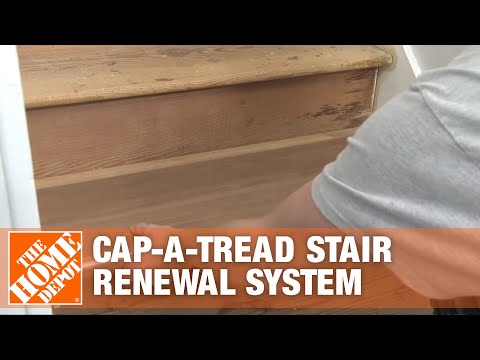
Measure Each Stair Tread Individually
30 minutesWork your way up the staircase, one step at a time. For each individual tread, use your flexible tape to measure the width across its widest point, which is usually the outer edge. Next, measure the depth from the very front of the tread (the 'nosing') to the back. Finally, use your protractor or angle finder to determine the curve angle. Taking these measurements from the same points on every step is key to achieving consistency and peace of mind.
Watch: Measure Treads and Mark Laminate
Create and Label Your Templates
60 minutesTo ensure your new treads are a perfect match, we highly recommend creating a template for each step. Simply lay your paper or cardboard over the tread and trace its exact shape, including the nosing. Carefully cut out the template. The most important part of this step is to clearly label each template with its corresponding step number (e.g., 'Step 1 from bottom,' 'Step 2,' etc.). This is especially critical for sharply tapered 'pie' steps. For your records, we suggest taking a quick photo of your labeled templates before sending them with your order.
Watch: Create Template for First Winder StepFrequently Asked Questions
What specialized tools are best for accurately capturing the curve of each stair tread?
A flexible measuring tape, a large carpenter's square or T-square, and a contour gauge are essential. The contour gauge is particularly helpful for accurately transferring complex curves from the stair to your template material, ensuring a precise fit for your new treads.
What's the biggest mistake people make when measuring curved stairs for custom treads?
The most common mistake is assuming that all treads on a curved staircase are identical or perfectly symmetrical. Due to construction variations, each step can differ slightly in width, depth, and curve. Always measure each tread individually and create a unique template for every single step to guarantee a perfect fit.
What kind of material should I use to create the templates, and why?
Stiff cardboard, poster board, or thin plywood (1/8" or 1/4" thick) are ideal materials for templates. They are rigid enough to maintain their shape for precise marking and cutting, yet manageable to work with. Avoid flimsy materials that can easily flex or deform, which would compromise the accuracy of your templates.
Is 3 hours a realistic estimate for measuring all the treads on a curved staircase?
The 3-hour estimate is generally realistic for an average curved staircase with around 12-15 steps. If your staircase has many more steps, very intricate curves, or challenging access, it might take longer. The project difficulty is intermediate, requiring patience and precision rather than advanced technical skills.
Are there any specific safety precautions I should take when measuring curved stairs?
Always ensure stable footing on each step, as the depth and width can vary. Use a sturdy stepladder if necessary for higher steps and consider having someone spot you if you feel unsteady. Keep your work area clear of tools and debris to prevent tripping hazards.
Why can't I just measure one or two treads and apply those measurements to all the steps on my curved staircase?
Curved staircases are rarely perfectly uniform due to construction tolerances and the way they are built. Each tread can have subtle, unique variations in its dimensions and curvature. Measuring each tread individually ensures every custom tread you create will fit precisely, look seamless, and be safe.